Mobility : a springboard to learning and
inclusion for young people
Project description
The project promotes inclusion by providing access to mobility for all young people, particularly those who are most vulnerable and have fewer opportunities, and who face obstacles such as barriers related to education and training systems, cultural differences, social, economic, discrimination-related or geographical barriers, or disabilities of any kind, health problems, etc.
In addition, the project combats discrimination and promotes equal opportunities, particularly for young people with fewer opportunities living in disadvantaged neighbourhoods or rural areas, giving everyone the opportunity to be informed, develop their skills and embark on a path that facilitates their employability or training.
Objective
The aim is to combat the social exclusion of young people from disadvantaged neighbourhoods and areas with fewer opportunities by giving them access to European and international mobility, enabling them to leave these areas and broaden their horizons and learning. Offering all young people the opportunity to develop skills and inclusion through cross-border, European and international mobility, facilitates their access to employment or training.
Expected results
– Organisation of personalised or group information activities (at least 15 group information meetings with young people with fewer opportunities per year); presence of young people or partners involved in youth inclusion (local missions, socio-cultural centres, France Travail).
– Participation via stands and peer testimonials at at least 10 public events such as European Month, association fairs, forums, neighbourhood festivals, etc., reaching at least 3,000 young people per year online and offline.
– Initial contact and personalised support: Identification of a programme suited to each young person based on their personal and professional goals: ERASMUS+ (exchanges, ESC, training or seminars), cross-border and international internships, au pair placements, woofing, volunteer projects, etc.
– Use of communication, employing non-formal education methods and promoting the skills acquired during mobility.
– Organisation of a weekend and preparatory workshops before the young people’s departure, developing their skills in relation to the socio-cultural, economic, health and safety contexts of the countries hosting the mobility programmes.
– Daily office hours to assist and support young people in setting up and participating in cross-border, European and international mobility projects within the framework of existing programmes: Erasmus+, cross-border programmes, Franco-German Youth Office, International Youth Solidarity, etc.; Identification of the programme best suited to the needs of young people;
– Creation of a database of 70 partners, cross-border, European and international; assistance in finding potential co-financing or self-financing; educational assistance and support in setting up projects and concrete actions (e.g. technical data sheets on activities for children during international mobility, summary sheet of good practice in “circular ecolonomy” to be presented abroad during mobility on the theme of sustainable development, etc.); assistance in promoting the project (how to report on and communicate about the project);
– Workshops and meetings with at least 50 young people will be organised to explain and master the tools for promoting skills (attitudes, aptitudes and knowledge) that will result from international mobility, based mainly on the Youthpass and Europass CV tools;
– Conducting reviews upon return: promoting knowledge, know-how and interpersonal skills, as well as capitalising on skills and testimonials; supporting capitalisation by creating at least 30 tools for promoting experiences and educational achievements (Youthpass, Europass CV, CV), as a springboard for their integration into the labour market;
– Other tangible tools will be created: summary technical data sheets on mobility schemes, an e-booklet summarising the skills acquired, a video testimonial and promotion of the project, etc.





Funded by the European Union. The views and opinions expressed are those of the author(s) alone and do not necessarily reflect those of the European Union. Neither the European Union nor the authority granting the grant can be held responsible for them.
Practical info
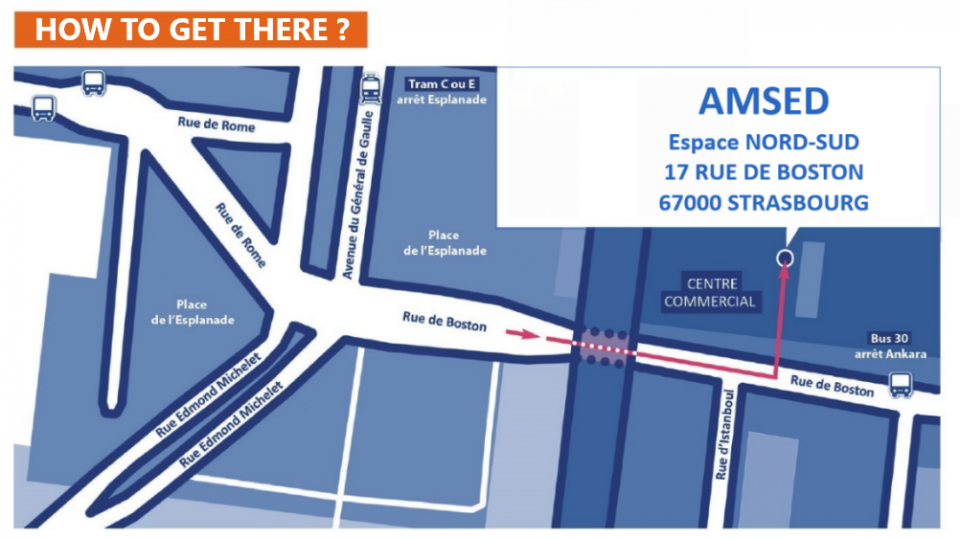
Address: 17 rue de Boston, 67000 Strasbourg
Access: Tram C and E (Esplanade) – Bus L1, 30 and 31 (Esplanade / Ankara stops)
Contact: mobilite@amsed.fr / contact@amsed.fr
Telephone: +33 (0)9 81 91 71 67 / +33 (0)6 61 34 26 03